Power in the Puddles: Eight Electric Trolleys for the Winter Walker
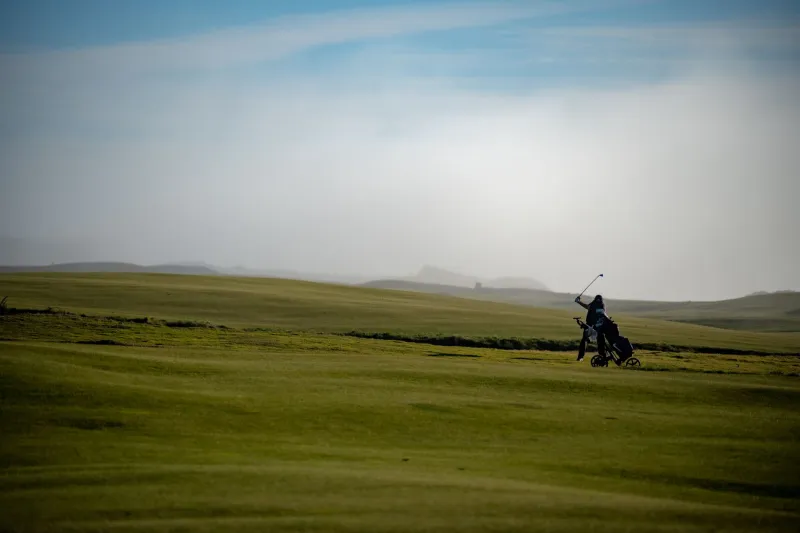
Winter golf in Britain is a test of patience as much as technique. Fairways soften, trolley bans appear on frosty mornings, and the walk from car park to first tee becomes a small expedition. For the club golfer who prefers to walk rather than ride, an electric trolley is less a luxury than a piece of essential kit — provided it can cope with mud, cold and the cramped boot of a family hatchback.
We spent the wet months of 2026 and early 2027 putting eight electric trolleys through their paces on parkland in Surrey, a exposed links in Kent and a hilly Yorkshire club where the 14th fairway might charitably be described as a ski slope. The aim was practical: to establish which machines suit the British winter golfer, and where the money is best spent.
How the test was conducted
Each trolley was used for a minimum of six rounds, in temperatures ranging from 9°C down to 1°C, with two rounds apiece in steady rain. We measured battery depletion over a standard 18-hole walk, noted stability on side slopes and across rutted ground, timed the fold-and-load routine into a 320-litre boot, and assessed the controls while wearing winter gloves. Prices are the manufacturers' recommended retail figures at the time of testing.
What the cold does to a battery
Lithium batteries are not fond of low temperatures. A unit rated for 36 holes in July may deliver 27 in January, and the difference is not always made clear at the point of sale. The better models now include a residual charge indicator that remains legible in dull light, and we favoured those that held their output rather than fading abruptly on the back nine.
The PowaKaddy FX3 (£549) was the most dependable in this respect, losing roughly a fifth of its summer range but finishing every round with charge to spare. The Motocaddy M5 GPS (£799) matched it for endurance and added a useful yardage display, though the screen dims noticeably in heavy rain. At the value end, the Longridge Eze Kaddy (£329) managed 18 holes comfortably but showed a sharper drop once the mercury fell below 3°C; for nine-hole winter rounds it remains entirely sensible.
Stability on slopes and soft ground
The Yorkshire round sorted the field. Wide-track models with a low centre of gravity coped best, and we noted that a fourth wheel — increasingly common — makes a genuine difference when traversing a camber slick with mud.
The Stewart Golf Q Follow (£1,299) was the most accomplished here, tracking its owner with unnerving competence and remaining upright on gradients that unsettled lesser machines. It is, however, a substantial investment and not the easiest to manoeuvre when switched off. The Hill Billy Terrain (£699) proved the more conventional choice, its broad wheelbase and chunky tyres dealing with rutted ground without complaint. The PowerBug GT DHC (£599) also impressed, its downhill control braking the trolley gently rather than letting it lurch.
By contrast, the lightweight Ben Sayers M9 (£379) felt skittish on wet cambers and required a firm hand. It is a fine summer companion and a reasonable second trolley, but not the machine for a soggy January medal.
Boot space and the loading bay
A trolley that will not fit is a trolley that stays at home. We folded each model and loaded it into a 320-litre boot alongside a stand bag, a pair of shoes and a modest amount of shopping.
The Motocaddy M5 GPS folds compactly and sits neatly on its side, while the PowaKaddy FX3 is similarly well-mannered. The Stewart Golf Q Follow is bulkier and demands more forethought, and the Hill Billy Terrain is best described as accommodating rather than elegant. The clear winner for sheer convenience was the Clicgear Rovic RV1E (£499), whose folding mechanism is intuitive enough to operate in the dark — a genuine virtue at 7.30am in December.
Controls in gloves and rain
Winter golf means gloves, and gloves mean that small buttons become an irritability. We favoured large, positive controls that could be operated by a thumb through a wet glove, and displays that remained readable when speckled with rain.
The Motocaddy M5 GPS and PowaKaddy FX3 both scored well, with generous buttons and clear feedback. The PowerBug GT DHC offers a simple, robust handset that does not demand a second look. The touch-sensitive panel on the Ben Sayers M9 proved fussier in the wet, occasionally requiring a second press. None of the eight failed outright in rain, which is a modest improvement on the previous generation.
Value at a range of price points
At £329, the Longridge Eze Kaddy is the sensible entry point for the occasional winter golfer, provided expectations are calibrated to nine or twelve holes in cold weather. The PowaKaddy FX3 at £549 represents the most balanced proposition in this test — dependable, compact and straightforward. Those who play year-round on hilly terrain should look to the Hill Billy Terrain or PowerBug GT DHC, both of which justify their premium in stability.
The Stewart Golf Q Follow is a remarkable piece of engineering, but it is difficult to recommend unreservedly to a club golfer who plays mostly in summer. It earns its place for the committed winter walker with a generous budget.
The winter verdict
Electric trolleys have improved markedly in recent years, and the best of this group are now genuinely suited to British conditions rather than merely tolerating them. Cold-weather range remains the most important specification to interrogate before purchase, and stability on wet slopes the most underrated. Buy for the worst round you will play, not the best, and the machine will earn its keep from October through to March.