The Equaliser Under Review: British Club Golf and the World Handicap System
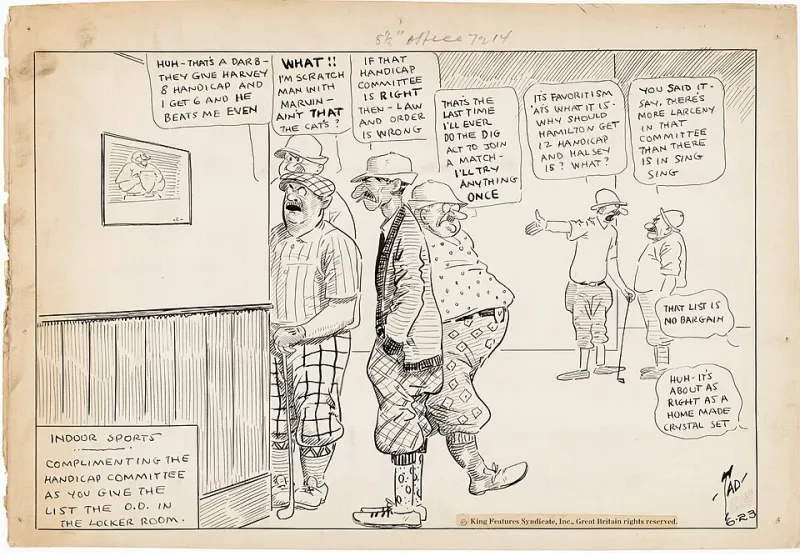
Photo: Tad Dorgan, Public domain, via Wikimedia Commons
On a damp Saturday morning in Cheshire, the roll-up is already three groups deep by half past seven. The tee sheet is full, the cards are printed, and the talk in the clubhouse is less about the weather than about the number beside each name. Six years after the World Handicap System (WHS) was introduced across Great Britain and Ireland, the handicap index has become a familiar piece of club furniture. What is less settled is whether it has made British club golf fairer, faster and more open — or whether it has quietly applied a handbrake to the way medals, matchplay and the weekly roll-up are run.
The WHS arrived in 2020 with a clear promise: one handicapping language for golfers wherever they played. For club players, the appeal was portability. A score posted in Cornwall could travel to a competition in Perthshire. A visitor from overseas could arrive with an index that committees recognised. The app-based calculation, the best eight scores from the last twenty, and the daily playing handicap all pointed towards a more transparent system. In many clubs, that promise has been kept. Handicap secretaries report fewer queries about away scores, and players who once kept private spreadsheets now accept that the index is a living number rather than a badge.
Yet the system has also changed the texture of club golf. The weekly roll-up, that most British of institutions, was once a loose arrangement of regulars who knew one another’s games. Now it is a competition with a valid handicap requirement, a score-entry process and, at some clubs, a debate about whether a roll-up round should be submitted for handicapping at all. The result is not necessarily worse, but it is more formal. Players who once turned up for a friendly nine holes now think about whether the round will count. Committees think about whether the field is large enough for the competition to be fair. The handbrake, if there is one, is applied by administration as much as by arithmetic.
The view from the committee room
Handicap secretaries are on the front line. A secretary at a Surrey parkland club, speaking on condition of anonymity, says the biggest change has been the volume of small decisions. “The system is clearer in theory than it is in a busy club office,” she says. “We spend more time explaining why a score has or has not been included, and why a player’s index has moved after a single good round. The maths is not the problem. The expectation is.” Another secretary in Kent makes a similar point. “The low single-figure player who has one bad medal can feel punished. The mid-handicapper who has one excellent round can feel rewarded beyond what the field expects. That is the system working as designed, but it does not always feel like it on a Saturday evening.”
Those feelings matter because they shape entries. At some clubs, medal fields have held steady. At others, Stableford and roll-up formats have grown while the strokeplay medal has become a smaller, more serious occasion. That is not a WHS failure; it is a cultural shift that the system has accelerated. Matchplay selection has been affected too. Selectors now have a portable index that can be compared across clubs, but they also know that an index earned on a short, tight parkland course may not transfer to a links course in a crosswind. The WHS has made comparison easier without making it perfect.
Among low-to-mid handicappers, the frustrations are specific. A 12-handicapper at a Yorkshire club says the system is “fine in principle, but it can feel jumpy”. A player who plays mostly nine-hole rounds or casual golf may see an index that moves more than expected when a strong score enters the record. The best-eight-from-twenty calculation is robust over time, but it is less settled for players with irregular playing patterns. That is a particular issue for the British club golfer who plays a weekly roll-up in winter and a handful of medals in summer. The system was not designed around that rhythm, and the result can be a handicap that feels less stable than the old club handicap.
A local answer to a global system
The governing bodies have resisted local variants, and rightly so. A single system depends on consistency. But clubs retain discretion over internal competitions, and some are using it. Several now publish clear local rules for roll-ups, nine-hole events and matchplay allowances. Others run “handicap clinics” before the season, where members can ask why their index has changed. These are small measures, but they address the real problem: not the formula, but the gap between the formula and the clubhouse conversation.
Is the WHS stalling British club golf? The evidence suggests not. Entries in many opens remain healthy, and the system has made inter-club competition more accessible. But it has added a layer of scrutiny to the weekly game. The case for a UK-specific tweak in 2026 is therefore less about changing the calculation than about changing how clubs communicate it. A clearer explanation of exceptional scores, a simple guide to nine-hole submissions, and a consistent approach to roll-up entry would do more than any local formula. The handicap handbrake, where it exists, is often a communication handbrake.
The WHS is now part of the furniture. The task for 2026 is to make it feel less like a piece of bureaucracy and more like a tool for the club golfer. That means secretaries being given time and support, players being told plainly how the index works, and committees resisting the urge to treat every movement as a controversy. The system is not perfect, but it is not the enemy. The enemy is the shrug in the clubhouse when a player says, “I don’t understand why my handicap has changed.” Fix that, and the handbrake comes off.